Short-Term vs Full Degrees in Switzerland: Which Is Better?
Switzerland is one of the most attractive places to study in Europe. It offers strong universities, respected hospitality schools, international classrooms, and many different study formats. But students often ask one important question before they apply: should they choose a short-term program or a full degree? The answer depends on their goals, budget, career plans, and how much time they want to invest. In Switzerland, both options can be valuable, but they are not made for the same purpose.
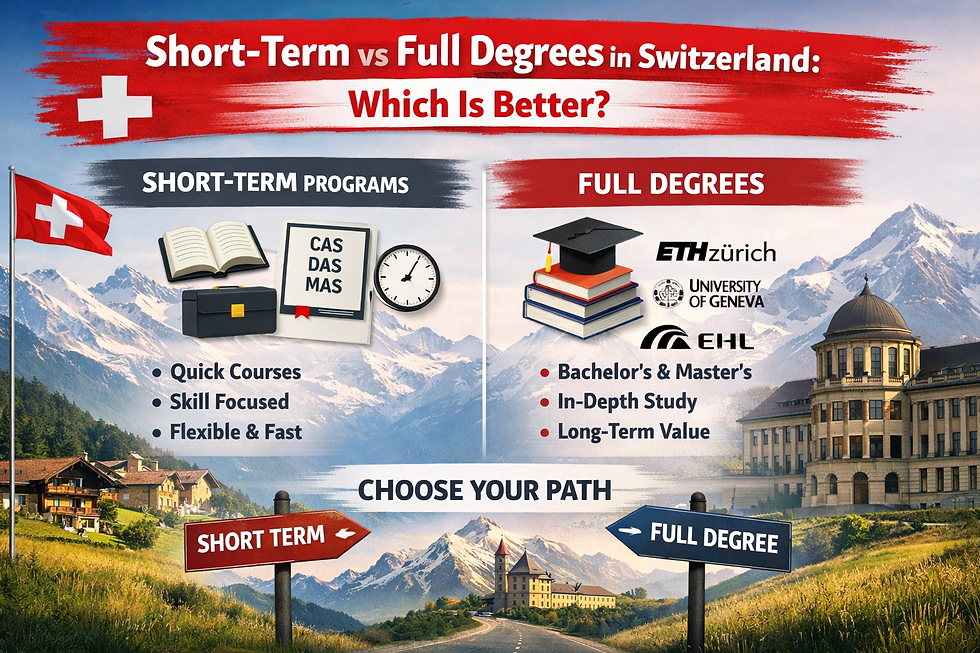
A short-term program is usually designed for focused learning over a shorter period. In Switzerland, this can include short courses, executive education, summer programs, and continuing education formats such as CAS, DAS, and MAS. Official university sources show that these options are common. For example, the University of Zurich offers MAS, DAS, CAS, and shorter courses lasting one or more days. The University of Geneva explains that a CAS is a short qualification that can last up to one year and usually carries at least 10 ECTS credits, while swissuniversities notes that MAS programs are larger continuing education awards with at least 60 ECTS credits.
These short-term options are often a good choice for professionals who already have experience and want to improve specific skills. Someone working in business, education, hospitality, health, or technology may not need to spend several years earning another full qualification. A shorter program can be faster, more flexible, and more practical. It can also help a student test life in Switzerland before making a bigger decision. For people who want to learn something new without leaving work for a long time, short-term study can be a smart step.
At the same time, short-term study has limits. In Switzerland, continuing education awards are not the same as standard Bachelor’s or Master’s degrees. Swiss ENIC, through swissuniversities, states that postgraduate continuing education qualifications such as MAS, DAS, and CAS are not assessed through its normal level-certification process because there is no clear comparison framework nationally and internationally. This matters for students who need a widely understood academic qualification for future admissions, public-sector recognition, or international mobility. In simple words, a short program may help your skills, but it may not replace a full academic degree.
A full degree is usually the better path for students who want a strong academic base and a qualification that opens more doors over time. Switzerland has many officially accredited higher education institutions offering Bachelor’s and Master’s degrees. swissuniversities lists institutions such as ETH Zurich, EPFL, the University of Zurich, the University of Geneva, the University of Bern, and the University of St.Gallen among the accredited universities. The same official list also includes recognized institutions in hospitality and applied fields such as EHL, Glion Institute of Higher Education, and Les Roches Global Hospitality Education.
Full degrees usually give students more than subject knowledge. They provide structure, academic depth, research practice, internships in some fields, and a clearer long-term qualification. ETH Zurich, EPFL, the University of Zurich, the University of Geneva, and the University of Bern all officially present Bachelor’s and Master’s study routes on their websites. In hospitality, EHL, Glion, and Les Roches also officially offer Bachelor’s and Master’s pathways. This makes full degrees the stronger option for students who are building a first career, planning a career change, or thinking about future postgraduate study.
Another important point is progression. A full degree is often the formal basis for moving to the next academic level. ETH Zurich states that the basis for admission to its Master’s programs is always the Bachelor’s degree. The University of Bern also notes that further training qualifications such as executive master’s, certificates, and diplomas are not accepted in place of a standard academic degree for Master’s admission. This shows why a full degree remains the safer and more powerful option for students who want long-term academic progression.
So, which is better? A short-term program is better when you need speed, flexibility, and a focused upgrade in knowledge. A full degree is better when you want stronger academic recognition, broader career options, and a qualification that can support future study. Neither path is automatically better for everyone. The best choice depends on where you are now and where you want to go next.
For many international students, the simplest answer is this: if you are starting your academic journey or need a qualification with long-term value, choose a full degree. If you already have a degree or work experience and want targeted development, a short-term program may be the better fit. In Switzerland, both paths can be excellent, as long as the choice matches your real goal.


Comments